Past Exhibition
Comfort #21
Lang / Baumann
18/11/23 – 21/01/24
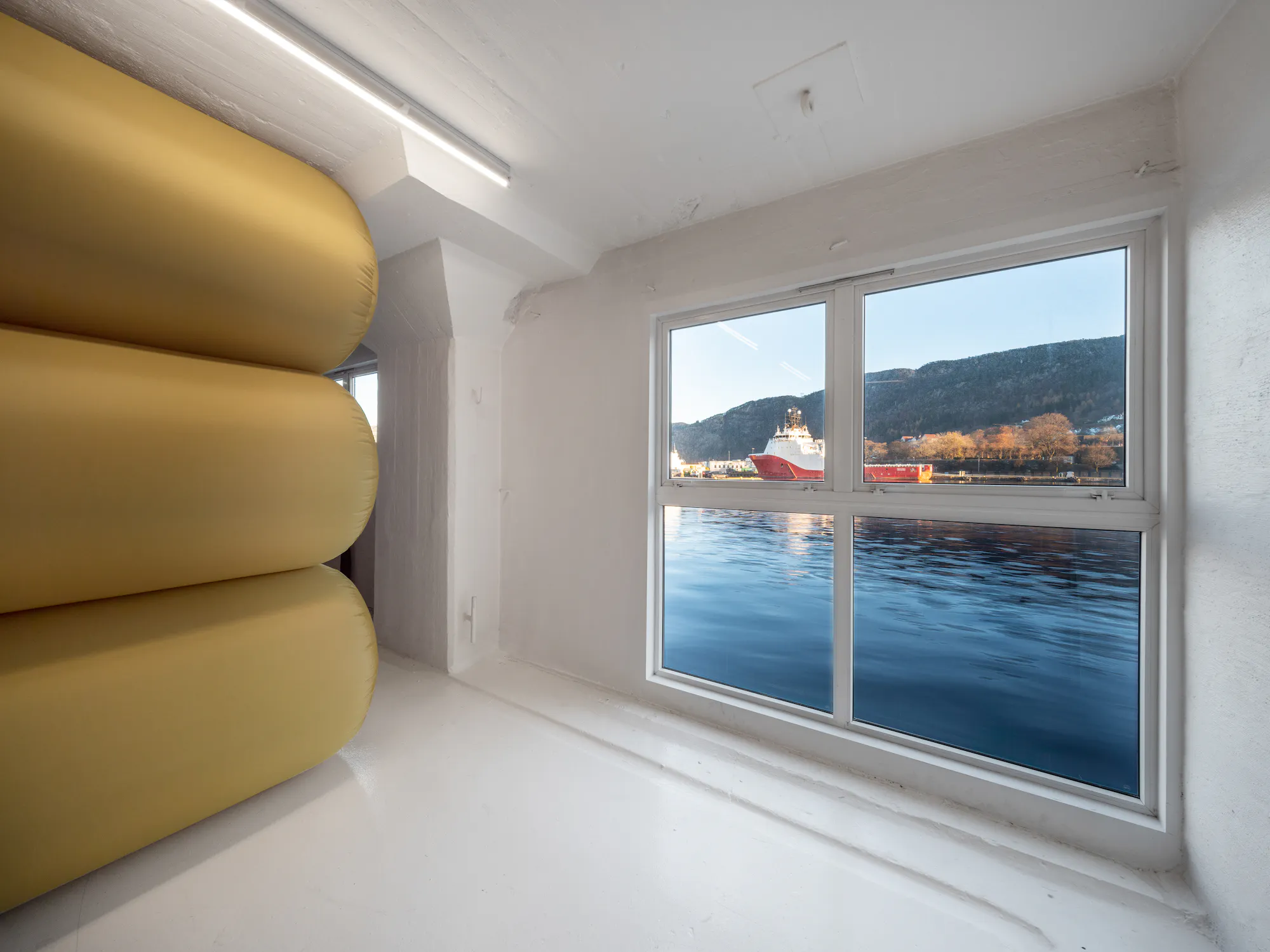
The Swiss artist duo Lang/Baumann’s new installation Comfort #21 is a transformation of the Aldea gallery space in central Bergen. The golden, textile, bulging volumes of an inflatable zigzag-shaped strip running the length of the gallery unsettle the geometric integrity of the space, which at other times is a classic white cube. Part interior architecture and part sculpture, Lang/Baumann’s work gives the gallery visitor an experience unlike any other: a functionless yet effectual form which creates softness where we’re used to feeling hardness, giving visibility to the otherwise invisible material of so-called empty space, air.
Importantly, however, Comfort #21 is not just about the immediacy of spatial experience, as significant as that can be. It’s also an intervention in two aesthetic histories which, in this moment, intersect perhaps for the first time.
The first is the history of Bergen’s built environment, and its related interior structures and surfaces. Catastrophic fires in 1248, 1561, 1855 and again in 1916 have cumulatively engulfed almost the entire city, incinerating by turns its distinctive timber buildings. Many of them were reconstructed with careful correspondence to the originals, meaning that, materially at least, the city is younger than it looks, a perpetual simulacrum. Or, like a snake, it has shed its skin several times.
In giving form to air, Comfort #21 reminds us that a building is a skin that can be shed, or a kind of membrane for holding air – like a balloon – before it is a shelter or a “machine for living in,” in the words of Le Corbusier. The tumescent planes of Comfort #21 simply point out that hard and soft surfaces can do some of the same things; they exist on a continuum, and when we look carefully into this continuum it becomes apparent that nothing is impermeable.
The second history in question is that of speculative architecture, a movement born in mid-Twentieth Century Europe in the crucible of postwar culture and infrastructure. Speculative architectural practices spoke back to the soulless functionalism of much post-war urban regeneration, and rode a new cultural wave of futuristic thinking inspired by the space race, science fiction, systems theory, computational innovations, and the panoply of techno-capitalist breakthroughs gestated by international conflicts.
What changed dramatically in certain architectural circles in Europe during this period, and in the 1960s and 1970s in particular, was a near-total detachment of the design and planning stage from the realm of manifestation. Suddenly, you could design something called the Walking City, as the British collective Archigram did between 1964 and 1966, and it would turn out to be a highly fictive set of plans for a city with legs, and not simply a city planned for pedestrians. Speculation at the edge of architectural possibility had as much to do with playful fantasy as it did with conjecture about the potential of
technology. Although the emergence of the internet was still decades away, the motif of a global city connected by a panoptic electronic infrastructure, striated by rapid travel, overwhelmed by information and glinting with machine-like finishes became something of a design cliché at the time.
There had, of course, been disciplinary porosity between art and architecture as far back as the Renaissance, but it was in the mid-Twentieth Century that the fields began to overlap at a conceptual level. This proximity was not without mutual antipathy, or complexity. The Dutch artist Constant Nieuwenhuis (known simply as Constant), whose speculative project New Babylon (1956-1974) always awkwardly straddled both disciplines, at one point said that New Babylon was “as real as any work of art” (1960), meaning that it was not very real at all. And indeed, the architectural fraternity, of which he at times aspired to be a part, were dismissive of New Babylon precisely because of its fantastical tone (it didn’t help either that Constant was an autodidact). But Constant’s musing on the (un)reality of art raised an important metaphysical problem: what is real, or not real, about artworks, particularly when they give us experiences that, at face value at least, feel authentic? Is there a “real life” through which art merely swings periodically like a pendulum, or does art contribute to the production of reality?
We might read Lang/Baumann’s intervention alongside this complicated intersection of art and architecture – via the register of speculation – because it entirely reimagines in microcosmic form what an urban space, what a cultural space, can feel like. And what a cultural space feels like is entirely bound up with what it is, its identity, the ways in which it is real. Comfort #21 strips the gallery of its seriousness, or rather, it reveals an inherent unseriousness in all our endeavours as cultural practitioners: the world doesn’t need us the way it needs shelter, food, water and air, and yet, at an existential level, it needs us now more than ever.
The notion of relevance is a frequent source of anxiety for artists and their institutions: we feel the need to justify our very existence, our compulsions to ride the pendulum. Aldea’s relevance to the art scene in Bergen is multi-pronged and profoundly pragmatic, and with this comes a temptation to view its curatorial operations as window dressing, an adjunct programme rather than its most meaningful contribution. With Comfort #21, Lang/Baumann focuses our attention on this picture, and insists that we examine our own views about relevance, importance, seriousness. The mere fact that the work is here, that it exists, that it absorbed resources, creates a space for speculation to live on.
-- Anthea Buys 2023
Lang / Baumann
Sabina Lang (*1972) and Daniel Baumann (*1967) live in Burgdorf (Switzerland) and have collaborated since 1990. Their body of work includes installations, sculptures, large-scale wall or floor paintings, and architectural interventions. The two artists work in a wide range of materials—wood, metal, paint, carpet and inflatable structures—but their true medium is space. Most of their works are site-specific, some are modular and can be adapted to different situations. Many of their pieces can not only be viewed but actually used as well while others merely feign usability or artfully subvert it.
Through careful prior analysis of the location and context of their interventions, Lang/Baumann initiate a dialogue with the existing situation, often playfully upending expectations and disrupting patterns of perception. With their opulent imagery they deliberately seek a delicate balance between clearly defined categories like public and private space, familiar and strange, art and functionality.
Featured solo shows have been presented at: Palais de Tokyo, Paris; Kunsthalle Bern, Bern; Swiss Institute, New York; Migros Museum für Gegenwartskunst, Zurich; Centre Pompidou-Metz, Metz; Victoria & Albert Museum, London.